


Protected: Two ways to estimate primary outcomes without polls (transcript)
This content is password protected. To view it please enter your password below: Password:...

In 2008, conservative email and websites propagated the false belief that Barack Obama came from somewhere other than his birthplace of Hawaii. In the New York Times in 2008, Sandra Aamodt and I addressed the neuroscience of why people came to adopt this belief. Now that Donald Trump is attempting to hide his five-year involvement in the “birther” movement, our piece is timely again.
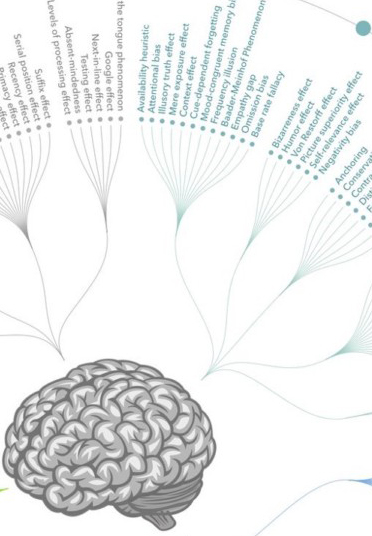
As my book co-author and I pointed out in our 2008 article, false beliefs can emerge from cognitive biases. Better Humans provides an excellent graphical compilation of such biases. For example, we have an innate tendency to mold information we recall into established mental frameworks. We tend to remember news that accords with our worldview, and discount statements that contradict it.
Birtherism took root with Republicans, including Donald Trump. The belief appeals to racist impulses. Obama’s ascent offends some people’s worldviews, as documented in this excellent essay by Jamelle Bouie. As Bernie Sanders has pointed out, Sanders’s father was also an immigrant, and yet Sanders does not encounter birtherism.
In this respect, Trump is just one of millions of birthers with a prior disposition to be skeptical of a black man becoming President. As the “birther” movement reached a peak, he got on the bandwagon with a series of public statements starting in March 2011. Trump’s statements in 2011 can account in part for his appeal in the GOP primaries, as an initial appeal to the approximately 40% of Republicans who hold the same belief. Psychologists have suggested that legends propagate by striking an emotional chord. In the same way, ideas can spread by emotional selection, rather than by their factual merits. By endorsing birtherism, Trump was building an emotional allegiances. As late as 2014, he was still pushing the idea. My guess is that he is susceptible to the same cognitive biases as his supporters – he’s one of them, only with a high profile as a reality-show star.
Now, in an impressive display of chutzpah, Trump and his supporters are attempting to spread the idea that an early proponent of birtherism was…Hillary Clinton. There is some chance that this very striking (and false) statement will work, at least with Republicans. If a message is initially memorable, its impression will persist long after it is debunked. In repeating a falsehood, someone may back it up with an opening line like “I think I read somewhere” or even with a reference to a specific source, even if the source did not originate the idea.
The risk that people will adopt this false belief is made worse by the fact that ostensibly credible news media sources do not always engage in factchecking. Television and cable news are the worst. As just one example, CBS News has repeated the Trump campaign’s claims about Clinton uncritically. The journalistic impulse to avoid “taking sides” can kick in, even when the two sides are “true” and “false.” Perhaps because it increases ratings.
Any successful strategy to debunk a false claim should include a replacement statement that is true, thus giving readers and viewers something to hold on to. Social media such as Twitter can help in rapid response – but can also propagate false ideas. What is needed is a response that debunks a false claim, and contains true information as well. Barry Ritholtz has come up with a possible media template for responding to this particular lie by Donald Trump. Such a template should include true “replacement statements,” such as the fact that birtherism originated in conservative chain mails, and was taken up by conservative outlets like The National Review.
I find it encouraging that such a template is available. Maybe it can be used by news organizations more generally, not just in politics, but in other domains such as vaccine safety or manmade climate change. For now, Trump is giving news organizations many opportunities for practice.
Obvious fixes for the problem of false beliefs do not work well. We cited one psychological study finding that when subjects were given evidence that disagreed with their beliefs, they were inclined to reject the evidence, even if they were given a specific instruction to “be objective.” In the same study, however, when subjects were asked to imagine their reaction if the evidence had pointed to the opposite conclusion, they were more open-minded to information that contradicted their beliefs. Apparently, it pays for consumers of controversial news to take a moment and consider that the opposite interpretation may be true. This strategy of “consider the opposite” works – but it requires a cool head. And the current media environment is anything but cool.
Finally, an obvious problem with Trump’s involvement in fringe beliefs: as the Republican Party’s presidential nominee, he normalizes those beliefs and speaks with the voice of a major political party. It is possible to cite his authority as a source. Through him, the path for falsehoods to take root in American minds is stronger than ever.
You neglected to mention that Trump’s own mother was an immigrant. His in-laws live at least part-time in NYC; it is my understanding they do not speak English, hence Barron Trump’s fluency in Slovenian (sounds like they get stuck as babysitters a lot!).
Zoiks. Neither side trusts the media anymore. The press is no longer free. Yellow journalism has returned.
It is not the birther lie. Trump has lied about Muslims dancing in the streets of NJ after 9-11, he “saw” the money transfer for hostages in Iran among many many others.
Thirty years ago, I thought the internet will get rid of false rumors and settle everything once and for all. Exactly the opposite has happened. Giuliani can assert that Hillary is dying by simply saying “look it up on the internet.”
Rumors still rule.
Sad.
As someone pointed out the internet makes the smart smarter and the dumb dumber…..this has been true even before the internet. But search engines make it easy to confirm your beliefs..
One question that should be asked of people who believe birtherism, deny climate change, etc., is “What kind of evidence would you need to change your mind?”
Mike, Would that we all spoke the same language. If we all had the same underlying assumptions about the word “evidence”and if we were all raised in evidence based “cultural soups”, that question would get reasonable answers. Unfortunately those who support Mr. Trump’s come from such different “cultural soups”. that even the subset of his supporters who have undergraduate degrees are unable apply the tests they’ve been taught for the purpose of separating valid information sources from the scurrilous.
Isn’t this what is commonly called “Gaslighting?”
Since I tend to be visual I appreciate the beautiful easy to read, easy to understand graph of the Cognitive Bias Codex. I admit that I saw some of myself in that graph!
The sad fact is there is very little value given to a politician that speaks the truth. In fact, they can be considered weak. What is not forgivable is being caught in a lie, like Nixon or President Clinton. That shows a lack of cleverness.
The Republican Party have long been past masters at creating and nurturing memes. There is only one defense; instantaneous and constant ridicule. You want to defeat a buffoon? Make it obvious they are buffoons.
The Donald has made this unbelievably easy. The present flip-flop is a perfect case in point. Laugh him off the stage, folks….
Trump who’s running a overtly fascist campaign is the culmination of decades of republican politics and policies tainted with racial bias and religious bigotry. Fox News with Roger Ailes have also contributed largely to the creation of this demagogue. In fact one could say that rational bipartisan politics died with the onset of the “Ailes Fox News Brand”. CNN and other MSM played along in view of their sagging ratings.
A world where latenight comedy shows are more factual then “real news shows” is somewhat troubling and proof that MSM/TV has become a construction for the modern American/world idiot.
Add Google with its algos to this toxic mix and we sure have gullible people enough to believe any lie and vote for a overt fascist, no matter how clear the picture is of Trump being a fascist. As facts will have the opposite effect on their mindset, as I had many times observed myself, I don’t see much that can be done except that after reading this i might approach people who support Trump differently and try to appeal to their imagination. But honestly I feel that this is a very hard task.
PEC’s data lag (and for a good reason) – Sam mentioned last week that he expected this downturn for Clinton in the data. Let’s see what happens by the end of this week…..
As my book co-author and I pointed out in our 2008 article, false beliefs can emerge from cognitive biases. Better Humans provides an excellent graphical compilation of such biases. For example, we have an innate tendency to mold information we recall into established mental frameworks. We tend to remember news that accords with our worldview, and discount statements that contradict it.
This seems to be true for everyone not just Trump supporters (not suggesting you’re saying otherwise). I don’t see much hope myself for cooperation between two large national populations who operate under mental frameworks that predispose them to view Trump’s lies as fundamentally worse than Hillary’s and vice versa.
The question is at what point does mutual hatred and contempt justify a radical departure from the status quo such as breaking up the country in a peaceful divorce along the Czech Republic-Slovakia model? That’s rhetorical of course. But it seems like a legitimate issue under the circumstances.
If you break up a country along ideological lines, you soon get two or more countries on each other’s borders arming themselves to kill each other to try to enforce their ideology. What were bitter ideological fights within a single country, become armed conflicts when that country breaks up into multiple sovereign nations which have a supposed legal right to “defend” themselves, even if what they claim to be defending themselves against is a fiction. That’s one reason Lincoln wanted to keep the Union together–he didn’t want to see an armed southern nation on the north’s southern border, making plans with its own military to cause trouble for the north or worse, based on the south’s paranoia (justified or not) about the influence of the north on the southern states’ institution of slavery. Lincoln knew that keeping the ideological differences within the single country, to be worked out over time, wasn’t great either, but he knew that nothing is perfect, and some things are worse than other things.
It’s as much or more a cultural divide as ideological. This country might already be on a path to serious internal violence like the former Yugoslavia. That’s at worst. The best case scenario is continued dysfunction. If the goal is to avoid violence, a peaceful breakup of the nation seems like it might be the way to go and ought to be discussed.
The break up of Czechoslovakia might be a thin reed to serve as model for the future of the United States, but the Czech precedent does show that sovereign nations can be dissolved peacefully when everyone determines it is in their best interests to do it. Czechoslovakia was a sovereign nation from 1918 to 1994 until it peacefully dissolved into the Czech Republic and Slovakia.
I can promise you there are very serious problems in the left-liberal cultural analysis of Trump’s rise, what it means, and the overall state of the country.
Even if Hillary Clinton wins the election which seems likely at this point, the despair, anger and desperation that has fueled Trump’s rise in the first place is not going to go away. It will still be there and likely lead to further and more extreme radicalization over time.
I can tell from my own reactions that repetition has an anesthetizing effect. What’s shocking soon becomes ho-hum. That’s why all the free air that Trump is getting is so pernicious.
On this thread, please direct comments to the subject at hand!
One small nit: You note that: “As Bernie Sanders has pointed out, Sanders’s father was also an immigrant, and yet Sanders does not encounter birtherism.” Well, that’s true today, but at one time it wasn’t.
There was a Federal Judge in Baltimore who, during WWII, had in front of him “five German born aliens seeking to become citizens who had fulfilled the conditions for citizenship. One was a Rabbi, another had already been accepted into the Womens’ Army Corps, and a third was married to a naturalized citizen who was serving overseas.” He refused to allow them to be naturalized because he had “instituted a policy of deferring final action on applications for citizenship of those who came to this country from Germany after 1933. He argued that the immigration law did not say that citizenship must be granted, only that it may be, and that the world situation made it impossible to make a proper investigation of the applicants.”
The more complete story is here: http://slnews.us/fb092016d
What you describe is not “birtherism,” but rather, simple discrimination. The judge didn’t question the facts, just refused to fairly apply the law.
I have to admit it’s been frustrating beyond belief to see how Trump’s followers will edit their memories to conform to what he says. First it was the fictional Muslims celebrating in New Jersey. Now it’s the birther stuff. It’s like the Jedi Mind Trick is real. Stephen Colbert said it brilliantly. Trump’s supporters know the birtherism belongs to him, that WHY they support him. I’ll never look back at horrible historical events like the Holocaust and wonder how they happened. We’re seeing exactly how they happened and will happen again.
Many good points, Marcia.
Brains are SCARY.
Colbert’s segment on the latest revisionist revisionism had the goods on video:
https://youtu.be/byP7XvzFqRc .
Orwell knew: ‘The past was alterable. The past never had been altered. Oceania was at war with Eastasia. Oceania had always been at war with Eastasia.’
Dr. Wang,
as you wrote in your book “false beliefs can emerge from cognitive biases”. But could these traits be genetically determined as Lewis & Bates published?
“Common Heritable Effects Underpin Concerns Over Norm Maintenance and In-Group Favoritism: Evidence
From Genetic Analyses of Right-Wing Authoritarianism and Traditionalism”
Journal of Personality 82:4, August 2014
DOI: 10.1111/jopy.12055
Do you agree with the results?
In terms of replacement statements–
It’s of note that when Donald Trump was making outlandish Birther claims, he and his associates referred fact checkers to the work of Jerome Corsi as their source. Corsi was the co-author — with GOP consultant Mary Matalin — of the Swift Boat Veterans book attacking John Kerry in 2004. In 2008, Matalin was the chief editor for the publisher of Corsi’s 2008 anti-Obama book, which factcheck.org judged ‘to be what a hack journalist might call a “paste-up job,” gluing together snippets from here and there without much regard for their truthfulness or accuracy.’
Then there’s Andy Martin — a prolific filer of vexatious and frivolous lawsuits and perennial GOP candidate for political offices including President — who proudly proclaimed himself “king of the birthers.” Martin began labelling Obama a “closet Muslim” and “unAmerican” just 2 weeks after Obama’s 2004 Democratic convention speech.
Sam, can you provide a link to the study you reference where people were given contradictory evidence and rejected it? I’m particularly interested in the second part — if I’m following correctly, it sounds like priming people with the possibility of there being an alternate viewpoint was more likely to open minds than focusing on direct evidence — I’d love to learn more about the details of that.
Should be linked from the original NYT piece.
The movie called the brainwashing of my dad does a good job of explaining the fox news effect and how people come to believe all sorts of made up “news”.
Another thing that may sometimes help when trying to get someone to see another viewpoint, is that just prior to offering them a replacement statement, to suggest to them that YOU are also willing to consider their viewpoint. This idea was promoted by Dale Carnegie, explained in his book “How To Win Friends and Influence Enemies”. One’s mileage with this method may vary.
Excellent start, but again treating both sides as equal is how we got here.
Backfire effect, where correction is observed to actually increase salience, has only been observed in conservatives.
Brendan Nyhan paper:
https://www.unc.edu/~fbaum/teaching/articles/PolBehavior-2010-Nyhan.pdf
Another prominent tactic used by those with redbrain tendency is flipping–
eg: Democrats are the REAL racists
“Hillary Clinton’s campaign first raised this issue to smear then-candidate Barack Obama in her very nasty, failed 2008 campaign for President. This type of vicious and conniving behavior is straight from the Clinton Playbook. As usual, however, Hillary Clinton was too weak to get an answer. Even the MSNBC show Morning Joe admits that it was Clinton’s henchmen who first raised this issue, not Donald J. Trump.
In 2011, Mr. Trump was finally able to bring this ugly incident to its conclusion by successfully compelling President Obama to release his birth certificate. Mr. Trump did a great service to the President and the country by bringing closure to the issue that Hillary Clinton and her team first raised. Inarguably, Donald J. Trump is a closer. Having successfully obtained President Obama’s birth certificate when others could not, Mr. Trump believes that President Obama was born in the United States.” -Jason Miller Trump spokesman
This is the one of the most diabolical, devious and duplicitously Orwellian political contrivances ever spewed in the history of politics. This type of mendacious chicanery should simply not be allowed to survive without vicious excoriation…and the fact that Priebus himself has humped this whore of a lie just makes it that much more deplorable and despicable.
The false balance reporting springs out of a flaw common to both journalism and academia – the need for ease and standardization. In academia, administrators use an automated measure (such as h-factor) to judge the quality of scientists. The underlying reason is the avoidance of diving deep enough (by reading their papers carefully and such) to fully understand the contribution of the scientist. The journalist similarly follows a template that absolves him/her of understanding or deciding the facts behind the story. Both reporting and academic assessment is thus standardized, and made poorer as a result.
Do any models (PEC, Electoral-Vote, 538, Kos, Upshot, etc.) try to take “ground game” into account, or is that just a complete and utter wild card?
The only thing I’ve seen that seems to have any bearing on it is Dave Wasserman’s tweets regarding registrations. But I don’t know if the 538 model takes those into account.
Speaking of 538, Silver and particularly Enten have becoming really irritating this cycle (on Twitter at least). They’re very defensive, although I don’t really know who they think they’re arguing with. Enten’s got an entire post today about how there are few signs of a Clinton “rebound,” while their own model shows a (small but clear) divergence at the moment.
Sorry, just had to vent a little. My mental health suffers every election year, but this is probably the worst one I’ve experienced. And there’s still three debates and over a month to go.
First off: no horserace commenting on this thread please.
Now then.
In 2004 I made an assumption about ground game giving John Kerry a hidden bonus. Really paid for that one, never doing it again. There are too many new mistakes to make! 😉
As for FiveThirtyEight…it is not really all that relaxing being an election prognosticator. I am trying to leave them alone. Probably they are getting heat for the high levels of uncertainty in their predictive model. It feels like they overdid it there – probably too many moving parts. But once they have set up their calculation, they are stuck with it. I am sure they are getting a lot of annoying comments.
JFCC & Dr. Wang:
1) there will be no external release of data on the ground games until the election, like 2012, because these are stealthy. Altho, both projects likely do have internal polling. Remember Rove’s very public meltdown on election night, and the epic fail of Orca, the GOP GOTV effort.
2) one can hypothesize that Project Ivy will be more successful for 2 reasons– a data legacy headstart of 4 years from OFA, and the nature of redbrain/bluebrain base demographics. In line with the theme of this post “missing white voters” seems to be a GOP fantasy given the red/blue enthusiasm gap– it is unclear that the OFA tactics used to turn out previously “hidden” blue voters would move the needle at all on the GOP side.
Silver’s evolution from pure quant to pundit was apparent even in 2012. I trust Dr. Wang analysis precisely because he’s an amateur– hasnt yet been captured by the media cartel.
🙂
The first thing to understand is that most of our knowledge, certainly most of our common knowledge, comes second hand. Everybody here knows that it is very cold in Antartica; who here has visited Antartica?
So,
1) False belief comes from reports. Contradictions come from other reports. Which do you trust?
2) Many people prefer top-down to bottom-up information. If they hear that tax breaks for the rich lead to faster economic growth, and they live through four tax breaks for the rich without experiencing any speed up in economic growth, they will still believe the generality.
3) Most people are innumerate, or at least non-quantitative in their thinking. If you ply them with numbers, they shut down like a kid whose parents are trying to get him to eat asparagus.
On (1), there has been a great effort on the part of the right wing to both provide alternative sources and to discredit “Main stream media.”
This is an interesting development– having given Trump a megaphone based on false equivalence and promoting clicks and eyeballs, can the media pivot to attack Trump’s falsehoods? Or is it too late?
It can take 10k repetitions to unlearn a single falsehood– will the NYT go there?
http://www.nytimes.com/2016/09/23/opinion/campaign-stops/donald-trumps-real-message-on-race.html?smid=tw-nytimes&smtyp=cur&_r=0
dead thread but i just came across this–
for the library
http://retractionwatch.com/2016/10/05/how-false-information-becomes-fact-qa-with-carl-bergstrom/
I don’t think correcting the Trump claim that Hillary started the birther rumor is really the point. Particular assumptions are themselves embedded within, framed by, and in fact are incoherent apart from their role in a larger worldview. Birtherism is a subset of a way of thinking about individuals of a different ethnicity or race as threateningly other. Its obvious Trump still sees Obama in those terms, which is why during the first debate, he boasted about being successful at forcing Obama to produce a birth certificate. It never occurred to him that the real issue was why he felt it necessary in the first place to question Obama’s place of birth. If you fight these
battles with questions at the level of individual fact(where was Obama born, is there climate change and what is its cause), you are doing something similar to parsing bible phrases . Unless you ascend to the super-ordinate level of worldview in addressing another’s interpretation of events, you may as well argue with yourself.