


Exceptionally Low Turnout Can Account For Polling Errors
At The American Prospect: Tweet In the home stretch, I wrote that midterm polling is far less accurate than in Presidential years. Today, in The...

Senate: 48 Dem | 52 Rep (range: 47-52)
Control: R+2.9% from toss-up
Generic polling: Tie 0.0%
Control: Tie 0.0%
Harris: 265 EV (239-292, R+0.3% from toss-up)
Moneyball states: President NV PA NC

Click any tracker for analytics and data
Apologies for the extremely light posting. Redistricting work (and democracy reform more broadly) is engaging. Plus there is neuroscience! But GoodFolk and Amir have spiffed up this site so nicely. So, here I am.
You may be focused on the House (likely Republican, with a meta-margin R+4%, gains of a few dozen seats) and the Senate (could go either way; snapshot 47-51 D seats, meta-margin R+0.4% from toss-up). Six races have polling medians within 5 points – New Hampshire, Arizona, Georgia, Pennsylvania, Nevada, and Wisconsin. Most of these races could all in the same direction…but which direction?
But let’s put that aside. There’s interesting and hopeful stuff happening at the state level!
Fair elections in key legislatures: Like I said on NPR the other day, redistricting has made a more level playing field in Michigan and Pennsylvania. Thanks to anti-gerrymandering efforts, those states will likely be majoritarian, giving control to the party that gets more votes (best guess: D’s in Michigan, could go either way in Pennsylvania). The news is less good in Ohio and Wisconsin, terrible Republican gerrymanders there.
In Nevada, some tea leaves suggest that polling errors may not be that large. According to Jon Ralston, a careful observer with a good track record, it looks like the governor’s race may go narrowly Republican, and the Senate race may stay Democratic. He bases this on careful examination of early and mail voting, an activity that he’s quite good at.
Election deniers on the defensive? My hope in democracy lies in state-level races. Key candidates for governor, secretary of state, and attorney general deny the honesty of the 2020 election, want to drastically change how votes are counted, and want to game rules to guarantee results for their own party.
As it turns out, they are not doing well – at least according to pre-election surveys.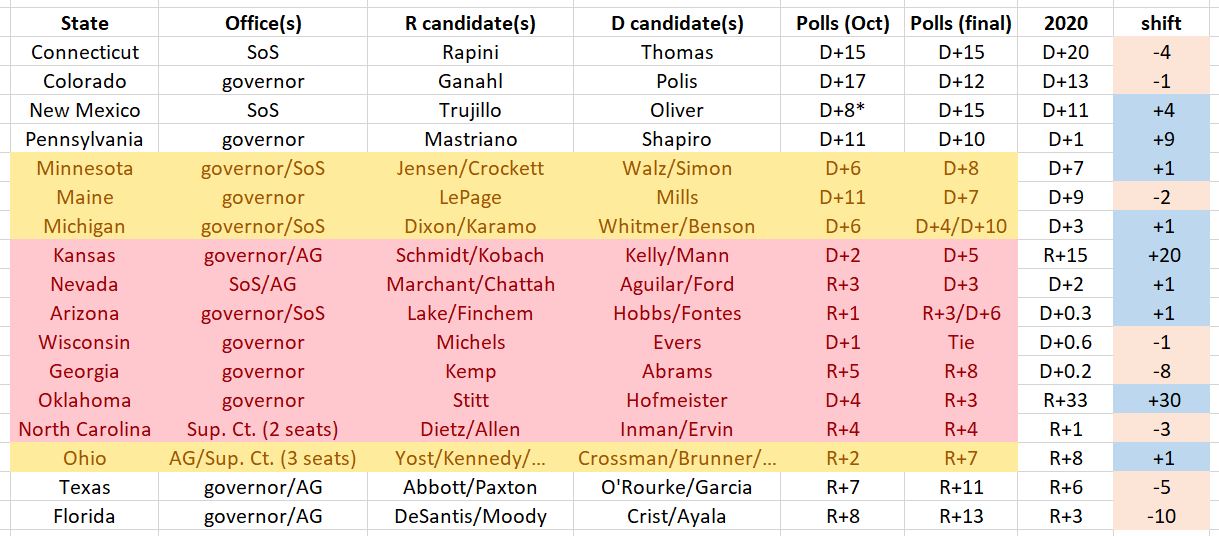
This table shows key races. The “polls” column shows recent margins for the first office listed, and where available, the second race as well. “2020” indicates the Biden-Trump margin. And shift indicates which way things appear to have moved.
Notably, across all of these states, denier candidates appear to lag the 2020 Presidential result by a median of only 1 point. I don’t know if that will hold up with today’s results. But if they do, it suggests that maybe a denier stance is not great for electability.
Key secretary-of-state and governor races appear to show denier candidates lagging. Secretary of state races are tilting Democratic in Michigan, Nevada, and Arizona, as well as governor’s races in Pennsylvania and Maine. Those are all really good news for holding normal elections in 2024. The same is true for the Georgia governor’s race, where Brian Kemp (R) oversaw a normal count, at least by post-2020 standards.
There’s an apparent tie in the Wisconsin governor’s race. Because of a heavily gerrymandered General Assembly, the governor is the only way for the popular will to constrain the legislature. And the Republican candidate, Tim Michels, recently said that if he wins, Republicans will never lose another election in Wisconsin.
Trouble in state supreme courts: Supreme Court races in Ohio and North Carolina seem poised to eliminate pro-voting majorities in those states. These courts reined in gerrymandering (or in Ohio, attempted to). Let’s hope for few election disputes in those states in 2024. The one long-term hope there is redistricting reform in Ohio.